Power and Covenant
Who Truly Possesses a Kingdom?
A political tragedy about the difference between controlling a kingdom and possessing its allegiance.
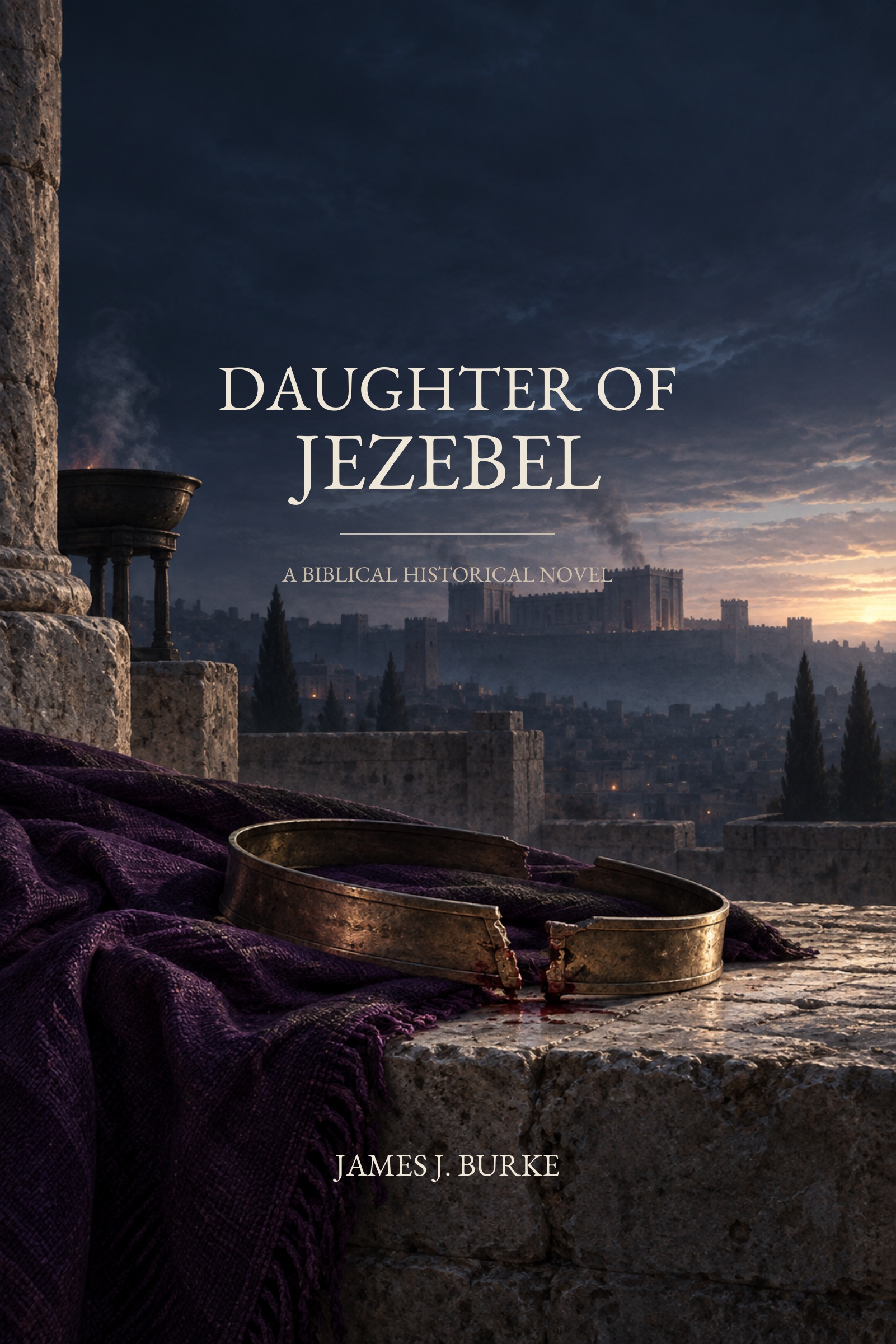
Athaliah enters Jerusalem as the daughter of a northern dynasty and discovers a kingdom governed by covenant, priesthood, and an ancient promise. She intends to master all three.
Set amid the violent alliance of the houses of Omri and David, Daughter of Jezebel follows one woman’s rise from royal bride to queen—and the hidden child whose survival will undo everything she built.
The complete 157-page digital edition is free. No account or email address is required. You may share the complete, unaltered edition noncommercially.
When Jehoshaphat binds Judah to the powerful house of Ahab, the marriage is meant to secure peace. Instead, Athaliah brings the political instincts of Omri and the gods of the coast into the house of David.
Across a generation of ambition, murder, rebellion, disease, and war, she proves herself more capable than the men around her. But while she governs the visible kingdom, an old priest and a king’s daughter guard a promise she believes she has destroyed.
The novel inhabits the reigns recorded in 1–2 Kings and 2 Chronicles, giving their public events the household, military, and political life required by historical fiction.
A political tragedy about the difference between controlling a kingdom and possessing its allegiance.
The public events of Kings and Chronicles given the household, military, and political life required by fiction.
When the royal line appears extinguished, its future rests with a woman’s courage and a priest’s disciplined silence.
Explore the people, places, chronology, and biblical history without revealing anything beyond the scriptural record.
Fresco-style portraits and concise biographies of Athaliah, Jehoram, Ahaziah, Jehoshabeath, Jehoiada, Joash, and the wider court.
See how the royal houses of Omri and David are joined—and where the novel responsibly fills a silence in the record.
Follow the cities, campaigns, and synchronized ages from Athaliah’s arrival to the seventh year.
Jerusalem rose out of the pale Judean hills like a fist of limestone thrust against the sky.
Athaliah stood within the curtained litter as the northern procession climbed the last steep road toward the city. Through the slit in the dyed linen, she watched terraced vineyards surrender to walls, towers, and the white blaze of the sanctuary above them.
It did not look like an empire. It looked like a tomb that had refused to stay buried.
The road narrowed beneath the gate. Judean elders waited in ordered ranks, their wool mantles dun against the stone. Beyond them stood priests in white linen, watching the cedar chests of her dowry as though northern silver carried contagion.
Athaliah met their eyes through the veil and did not blink. Let the priests glare. Her mother, Jezebel, had broken far louder men on the slopes of Carmel.
James J. Burke is the senior pastor of Grace Community Church in Marinette, Wisconsin. He writes with the conviction that careful theology should strengthen ordinary believers, not merely impress specialists.
James is the founder of Fireproof Commentaries, a publishing ministry devoted to rigorous, Christ-centered resources for pastors, teachers, and thoughtful readers.
A professionally formatted 6 × 9 book interior with the complete, unabridged manuscript.